|
Mon 7 Aug 2012 06:39
Amy Hollinger-King
of Dumas, Arkansas, writes in response to "A Big Dog and a Large Time," Joseph Dempsey's Photo of the Week of July 29, 2012.
Hello, Mr. Dempsey!
My husband and I met your son, Doug, at Dumas' Ding Dong Days last weekend. He took notice of our two English Mastiffs, Boss and Ben, and began shooting several pics of them.
Doug sent me an email to let me know that he posted some on his website and that you had used one of them on your blog site. Cute blog about the dog, but just wanted to correct the name of the dog used in your blog. His name is actually Boss and he is very mild tempered....he'd rather sleep than anything else!
When Doug ran into us at DDDD, we were actually on our way to the Ainsworth Pet Nutrition Dog Show at the festival. We entered both dogs, but Boss (your Photo of the Week dog) won the male division!
We were swarmed by children wanting to pet them at DDDD, and one kid even called him the "Camo Dog" because of his brindle coloring and hunter orange collar and leash....but I think it's funny that your granddaughter called him "Richter"!
I really enjoyed seeing all of Doug's shots of Boss and Ben and seeing your blog about Boss!!
Amy King
Dumas, Arkansas
amyhollinger@hotmail.com
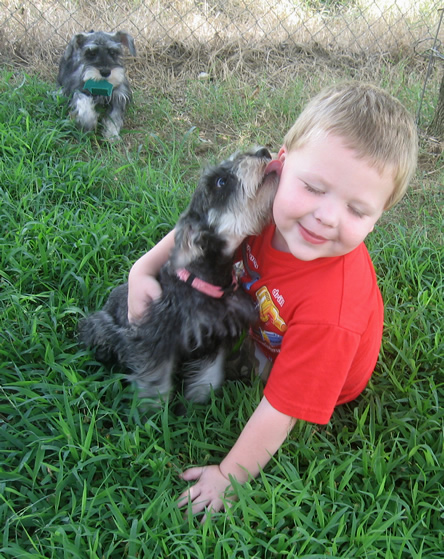
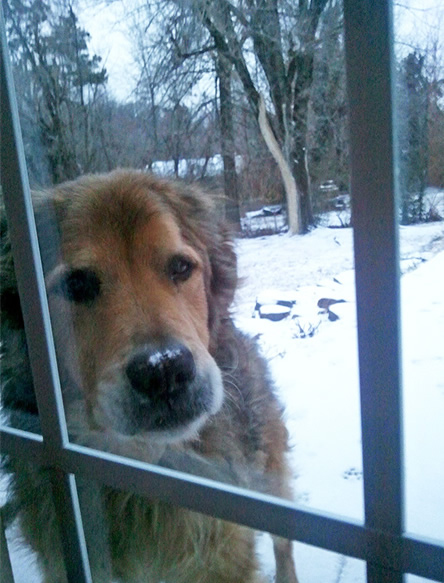
Some time back we asked OUR READERS to send photos of their dogs and other special pets along with a story or two about their honored place in the life of family and home. Now we have our own little pack of CornDancer cyber hounds: Lexi, Yoda, Mufurc, Suzy, Jake, Yellow Bear, Brown Bear, Little Zack's pup, Max, Cleo, Britches, Spice, Gandalf, Isis, and Ulysses. (Linda's two cats and Lexi's feline pal Domino also showed up to add some spice to the mix.) If you browse a spell, you'll find each of 'em somewhere on this page.
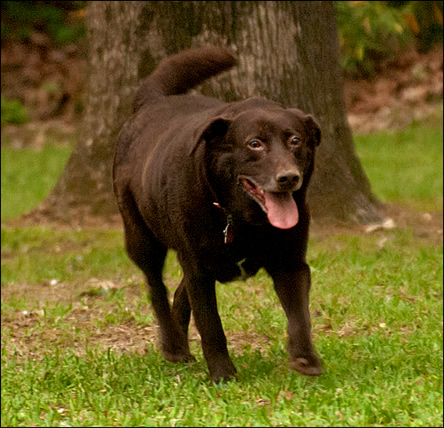
Today we welcome Cocoa to the pack. Cocoa became a sky dog on April 25, 2012. Look closely, and you'll see her running across the heavens on soaring clouds with the other sky dogs at play. Cocoa's story is printed below.
R E Q U E S T :
Masters and keepers of the hounds are encouraged to send their dog pix along with a bio or dog story to us at threadspinner@corndancer.com Why? These are communal threads that bind us together, disparate though we may be, trudging the happy road of destiny.
Joseph P. Dempsey
of Pine Bluff, Arkansas, sends a photo of Cocoa and shares her story.
Cocoa gallops on the LA grass.
Thu 4/26/2012 21:18
Cocoa's life ended today. It started some 15 years ago or so. No one knows for sure because whomsoever was in charge of Cocoa, her mother and her siblings dumped all of them on the side of a road and drove off. There were two survivors, puppies Cocoa and Yoda.
We discovered Cocoa and Yoda courtesy of my friend, the late Henry Marx. I was walking the late Sophie, our first Rottweiler, when I ran into Henry exiting his vehicle in front of Betty Garman's house. Henry promptly informed me that I needed another dog. He was right. We had discussed finding a partner dog for Sophie. Henry then told me that Betty had two puppies she had taken in and was actively seeking responsible parties to adopt them. Henry took Sophie and I to see the puppies, one black, a male, and one brown. When they saw Sophie, they were terrified and ran to, and tried to bore a hole in, the brick wall of the patio. I liked the little black guy, but thought the brown one was cute as well.
I took the news home to Pat and subsequently we went to see the pups. We left with the black one. Yoda. We learned much later that some friends had adopted Cocoa. She eventually wound up with one of my friend's relatives who was partial to critters. All was well with Cocoa. Then her owner fell ill and was admitted to long-term care. Responsibility for his critters reverted to my friends, who knew we had Yoda, Cocoa's brother. We were an obvious prospect to adopt Cocoa and eventually did, along with one of her partner critters, Chessie the cat.
At first, she did not take well to her new home. The minute our backs were turned, she made her way back to her old digs. This happened off and on for the first three or four weeks, then she decided that this was her home. She proved it by barking her head off when a suspicious stranger dared set foot on the premises. She was a good a watchdog as ever put four feet on the ground.
Cocoa and Pat developed a special bond. Their walks were the height of their respective days. Last Tuesday evening, we noticed a slight swelling under her jaw and figured it was her thyroid condition acting up. Wednesday morning, Cocoa's brown face was badly swollen. Pat rushed her to the vet. It was touch and go, but by Thursday morning the plain, hard truth was she would not survive what we suspect was a snake bite.
This evening she will join Sherman, Sophie, and Grits in the back yard. She was a good dog. She leaves behind Yoda, Cleo, Ruby, Chessie, Katy, and Sooner. And us.
Joe
Pine Bluff, AR
jdempsey@cablelynx.com
Jeff Evans
of Pacific Palisades, California, writes in response to "Who Is John Carter?", Ron Fritze's review of the movie John Carter (Planet Clio on 20 March 2012). Jeff provides executive coaching and leadership development through his consulting service, Envision Global Leadership.
Tue 3/20/2012 21:31
Ron,
Stellar review. Well done — an entertaining romp through the story of the film, and the history of the story, told with your unique blend of wit, insight, and the occasional hint of cynicism. Intelligent, insightful, literate, and still with the flavor of a good friend talking about his weekend. I personally did not know the story, and had no interest at all until now. All that has changed for me, though. Now it looks like a bit of a learning project, and I certainly want to go see the film, after I read the book.
Best,
Jeff
Pacific Palisades, CA
jeff.evans@eglead.com
Gary W. McCullors
of Athens, Alabama, also writes in response to "Who Is John Carter?" Gary is director of Information Technology at Athens State University.
Wed 3/21/2012 08:58
Hi Ron,
I hate that the movie is not doing good, but I think a lot of it is because, as you mentioned in your essay, not many people know of him. I think you are absolutely right; if they had marketed it as A Princess of Mars, it would have probably pulled a larger sci-fi fan base.
I don’t remember where I got my copy of the A Princess of Mars book, but I read it several times after discovering it. At that time, I didn’t know very many people who read for recreation, so I didn’t have anyone with which to swap books. I eventually got to read the second and third books.
Thanks for the essay. I really enjoyed it.
Gary
Athens, Alabama
gary.mccullors@athens.edu
In an e-mail announcing a new feature for Crow's Cottage Glossary and Compendium, "Isis, Ulysses, and Gandalf," we asked OUR READERS to send photos of their dogs and other special pets. To our immense reward, the call for photos brought several responses. Now we have our own little pack of CornDancer cyber hounds.
All good dogs are welcome to join CornDancer's cyberpack. Masters and keepers of the hounds are encouraged to send their dog pix along with a bio or dog story to us at threadspinner@corndancer.com It's painless, safe, and totally free!
Karen Steele
of Dodge City, Kansas, sends two photos:
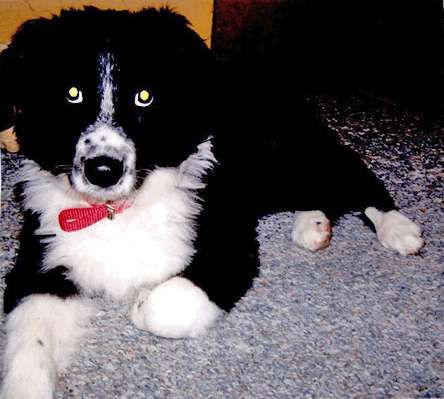
Lexi the border collie lives in Kansas with Karen.

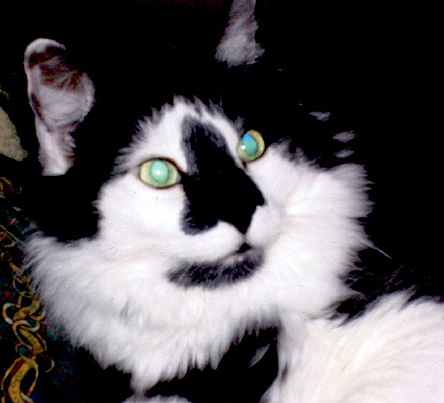
Domino is Lexi's sometimes reluctant playmate.
Mon 04/11/2011 17:09
Dear Eb,
We adopted Lexi in January 2010 after losing our Australian shephard Jane of nine years in December. We picked her up at our local animal shelter after someone had thrown her over the fence — they didn't even bother to take her inside.
She was timid in her little pen as we went round and round trying to see if there was a dog meant for us. The shelter would let us adopt on a certain day, and another man was interested, so my daughter set outside the shelter for an hour before they opened so she could claim our Lexi.
Once we took her home we wondered if we had the wrong puppy as she quickly came out of her shy, scared temperament. My son kept her in a pen in his room while we were at work, but she continuously broke out, so we bought the largest pet taxi (crate) we could find,and she did real well with that. In the evening when she was tired, she would go to the crate, kick it open with her paw to let herself in, lay down and fall asleep. Some days she'd drag the pillow out and lay on it.
My son's girlfriend taught her to sit and shake in less than a day — actually less than an hour. She is very smart.
One evening Lexi was quietly sitting just inside the bedroom door when, all of a sudden, she leaped onto my son's lap (he was sitting in a straight-backed chair playing a video game), and in one motion bounced onto a very high bed to land in the middle of my son's girlfriend's lap. It was like she had been sitting there, figuring all this out just before she sprang into action.
Lexi is very protective of her family. She can't understand why the cat won't herd for her — they both kinda go round and round. She amazes us with her intelligence and silliness. A pure joy.
Karen
Dodge City, KS
karen.steele@ksoutdoors.com
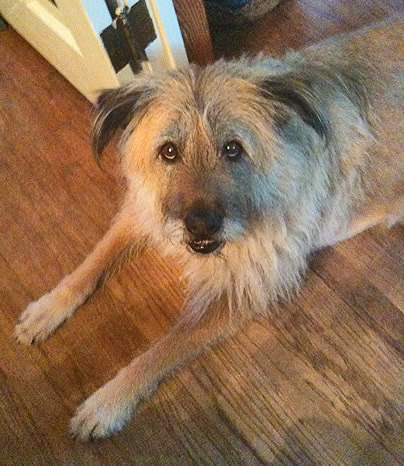
Yoda
Joe Dempsey
of Pine Bluff, Arkansas, is Yoda's companion. Joe sends this dispatch:
Tue 03/01/2011 05:35
Yoda has been a member of the family for nigh on to 13 years. He and his sister Cocoa were the sole survivors of a litter and their mother, which some scurvy miscreant jettisoned on a roadway. The two survivors were found near the run-over and mangled bodies of their mother and siblings. They were taken-in by a kind soul who cleaned them up, fed them, and made them available for adoption. We were looking for a partner dog for our late Rottweiler, Sophie, and Yoda filled the bill.
When we went to pick him up, we took Sophie. When the yet-to-be-named Yoda saw Sophie, he panicked and attempted to bore a hole in a brick wall to escape the giant, who would become his partner. We calmed him down the best we could and took him to his new home. I named him Yoda because of his ears.
He quickly learned to socialize with Sophie. The former apparition which once scared him out of his wits soon became his joined-at-the-hip partner. The two were inseparable.
When people would see Yoda, they would ask me what kind of dog he was, time and time again. In my mind, his provenance made not a bit of difference to anything. A bit miffed, I concocted a myth to explain his breed. From that moment on when asked "what kind of dog is he?" I quickly responded that he was a "Patagonian Water Dog," a rare breed. I further explained that the breed originated in Patagonia where the environment is harsh. "They needed a dog with the hardiness of a Labrador Retriever and the agility of a Cattle Dog. So they developed the dogs from those breeds and Yoda is one of only two in Arkansas," I lied.
Most, if not all of the targets of this legend took the bait hook, line, and sinker, responding with rejoinders such as, "Yeah I've heard of those dogs," or more popularly, "You know I saw something on television about those dogs." I revealed my secret to a few close friends and left the rest with the wool firmly pulled over their eyes.
Cocoa, Yoda's sister, went to another family after their rescue. She finally wound up with an uncle in the family. He contracted cancer and was moved into a long-term care facility. The family members, who are friends and clients of my business, knew that we had Yoda, and asked us if we would take Cocoa. Our round heels worked to perfection upon this request, so now we have not one, but two Patagonian Water Dogs — the only ones in the state.
Joe
Pine Buff, AR
jdempsey@cablelynx.com
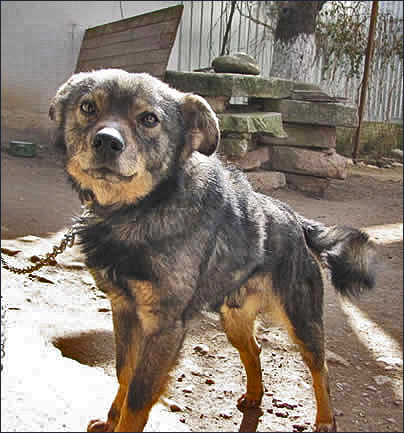
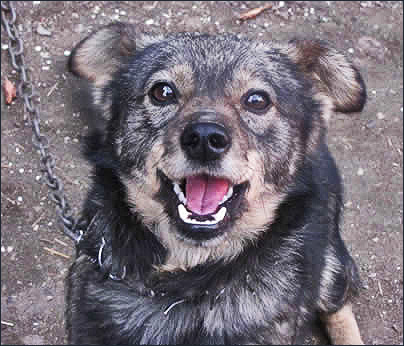
One of our dogs took the time to write a special letter. He sent it to us all the way from Transylvania. His master included some photos, too.
A Dog's Letter to Crow's Cottage,
Over the Ocean
Mufurc is happy to be at home in Transylvania.
Sat 02/12/2011 16:14
My name's Mufurc. You, there in the USA, should pronounce it 'mufurts according to the international English phonetic alphabet. My name means ”sulky, but nice” in Hungarian.
I live in a small village, meaning a rural settlement in British English — at least that’s what I understand from my master's mutterings in his several languages. Well, the place is in Europe, Romania — I know from my master that sometimes it is not a very good place, but home is home. My master has other problems with his homeland. Sometimes he tries to explain me that we dogs probably have our mother tongue diversities, but I don't understand such human reasonings.
Well, my life story begins without a reasonable beginning. I don't remember who my parents were, but I do remember that one day, when I was very young and very scared and very hungry, I saw a huge something making considerable noise and extremely stinking smoke, from which, to my stupefaction, a lot of people were coming out. I don't understand even today how it could happen, but I was cold and hungry at that moment, and I was looking at the humans getting off the something (maybe a bus?), and two beings came closer to me, and they touched me before I could react.
That moment was a decisive one in my life, as I couldn't stop myself from following those beings after they touched me. They moved forward maybe some hundred yards, I following them. Before they disapeared behind a fence, they stopped and stretched hands towards me. I was overwhelmed by a strange feeling, and couldn't stop from going with them into that unknown place on the other side of the fence, and being together with them.
First I was scared because they started laughing — I know today the noise they were making is called laughter, but I didn’t know what it was back then, just that it was strange and scary — but one of the humans came close to me, and touched me, and then I wasn’t so scared. That's all I remember of my first day at my place.
Mufurc poses for his master's camera.
My older master sometimes tells me in his language, which I understand only vaguely, that I am a dog and he is a human, and that I am a lucky fellow. Of what I remember, the first day I had a lot of food and I slept on something warm under a roof, which later I understood was the threshold of my master’s house, and the warm thing was a door-mat.
After a couple of days, while I was feeling more and more comfortable in my situation, my old master asked the younger ones if they wanted me. (Of course, all these things I know from later tellings and experience.) I don't really remember their answers, but later I understood that my older master asked the younger ones if they want me as a dog, as a dog needs a place of his own, a house, and a chain, as humans have.
The answer must have been yes, as that evening I got a house of my own, made of nicely smelling wood, and a neckstrap. I didn't like the neckstrap, because when my master put it on me, he also attached a chain to it. I felt my little head ten times heavier, but my master kept on caressing me for quite a long time, and then I understood: God gave me the chance to be part of a bargain. If I accept it, I can be part of a family, limited to some hundred square meters, where I myself can enjoy my dog’s life. I can have my own vessels, one for food and one for water, my own house, and daily food and water — and what has become very important during the last eight years, my human company.
Well, it is important, the company of my humans. It's true, once or twice a year comes a stranger, who doesn't seem to be an enemy, but who makes me suffer for a short time. My master always tries to explain to me that the stranger is very important and not an enemy. The day when this stranger comes, my water tastes rather odd, but I drink it anyway. On these occasions I also get a painful injection.
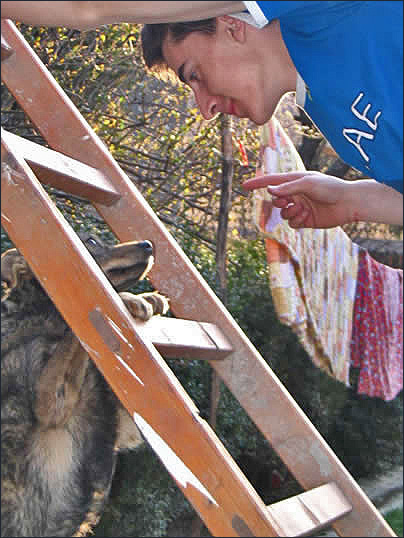
One of Mufurc's humans is saying, "Don't bark at cats."
I have my way about three or four times a month, which means that my older master takes off the chain from my neck and lets me run in the courtyard until I get tired. When he puts back the chain, he always says that he has a chain, too, and that he can hardly get rid of his. I start realizing that humans have some invisible chains, though they seem to be totally free.
My master sometimes tries to explain that chainlessness is not a valid value on Earth. All beings must have chains, otherwise the world goes wild. Humans know a lot of frightening stories about going wild. I don't understand, but my master says that wild animals are OK irrespective of this. Still, I don't understand why and how humans can become wild.
I become angry when homeless dogs come into my sight. My master always tells me that no one is an enemy who doesn't trespass. Still, there are a lot of trespassing cats. I sometimes wake my master's family from their sleep because of trespassing cats. When this happens, they are shouting at me, but in most of the cases I can't stop barking at trespassing cats.
Well, I haven't told about my house! I know that not all beings have a house or nest, as my master likes to mention houses. A house protects one from cold, rain, and snow. Though I don't mind if it rains.
I like to sleep in my house only in wintertime. During the warmer period of the year, I sleep outside. I don't mind if I am wet, but I'm extremely afraid of thunders. Though an adult dog, I admit I can't stand thunders. The same is true for fireworks, though my master comes to me several times on New Year's Eve to caress and comfort me. He tries to explain that he is not encouraging me to be afraid, on the contrary. I suspect not all humans are like my master. I'm sure those who blow fireworks are also some kind of humans, but not like my master.
I have never been in my master's house, but I like sleeping on the threshold. Whenever, by chance, my chain breaks, I always sleep on my master’s threshold. I understand that I am a dog and he and his are not. I sometimes understand my master’s conversation with his human guests. They often talk about old values. They say it's all right if a dog lives in his outer house. But if it's very cold, I get hay under myself.
And humans fear God. I don't really know who that is, but I'm sure I am part of my master’s world. And everything is all right as it is.
With special regards to all American dogs, and with dogly love, I remain, your friend,
Mufurc
P.S. Please hand over my special consideration
to your masters, also.
Translated from Dog's language,
Transylvanian dialect, Hungarian flavor,
by Zoltán Boldizsár Zeyk, my master, a human.
boldizsarzeyk@yahoo.com
Herb Peach
of Little Rock, Arkansas, sent the first reply to our call for dogs.
Herb sends these photos:
Suzy lives at Herb Peach's home.
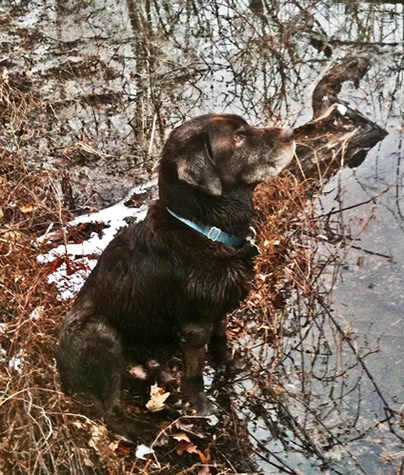
Jake likes to hunt ducks with Herb.
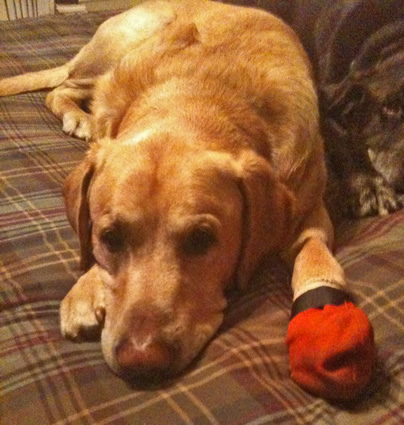
Yellow Bear's foot is healing.
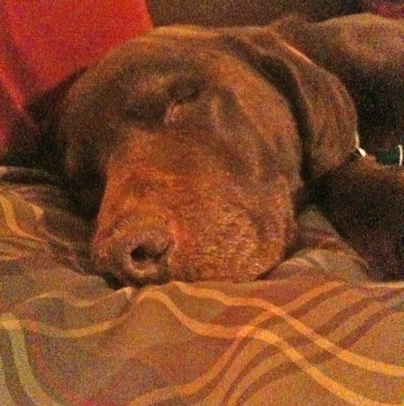
Brown Bear has a bad back. He likes to sleep.
Thu 01/20/2011 17:14
Dear Eb,
I’m always glad to hear from you, and the pups are beautiful!
Our pups are ageing.... Suzy about 16, Jake is 10-1/2 with heart condition and kidney failure, Yellow Bear is nine, and he stuck a stob into his paw, and it got infected, and Brown Bear is 13 -1/2, and very poor in the back.
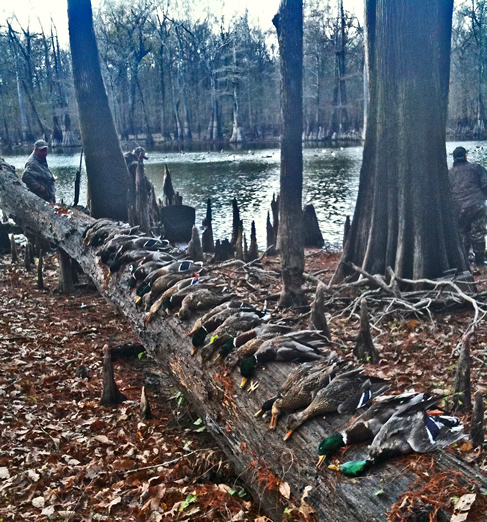
Duck season has been fantastic. We started by serving NY Strips to 56 on the night before opening day, and you can see from one of the pix, hunting has been extremely successful.
My Best!
Herb
Little Rock, AR
herbpeach@att.net
Rewards of the hunt in the White River bottoms
Carol Apple
of Belleville, Arkansas, sends this photo:
Little Zack loves puppies.
Thu 01/20/2011 19:44
Dear Eb,
My daughter has a kennel, and her son Zack has been the chief socializer of the puppies almost all his life. He loves his job and is also doing well as a salesman. This young dog found a home about 20-30 minutes after this picture was posted on the Internet.
Carol
Belleville, AR
capple@arkwest.com
Linda Hagen
of Van Buren, Arkansas, sends this photo:
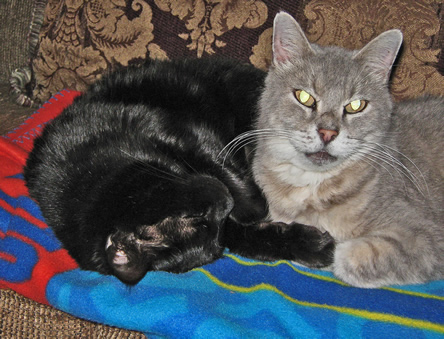
Stayin' warm together
Sat 01/22/2011 19:45
Trying to stay warm together on cold wintry days has two cats, who at times fight with each other for owner approval, cuddling on a warm blanket.
Linda
Van Buren, AR
hagen.lhagen@gmail.com
Pat O'Brien
of Fayetteville, Arkansas, sends this photo:
Good old Max
Mon 01/24/2011 13:43
Hi Eb,
Enjoyed reading your musings on the pack. I liked the “canine energy” reference. This shot of Max seemed to capture where he’s at on “life’s highway.” If there’s a Florida for dogs, I’m sure he’d vote to go there.
Pat
Fayetteville, AR
maxobrien@sbcglobal.net
Joe Dempsey
of Pine Bluff, Arkansas, sends this photo:
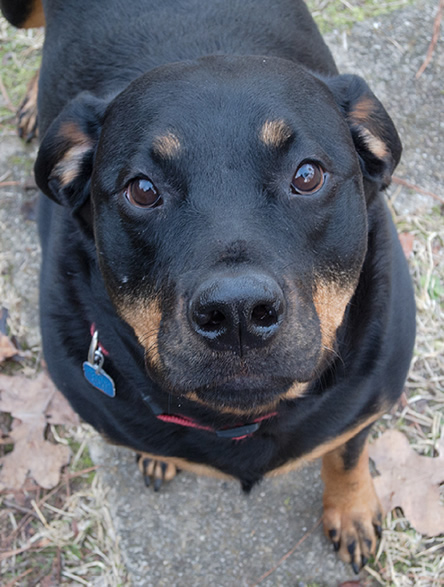
Cleopatra Shameka Beatrice Glover-Dempsey
Wed 01/26/2011 16:12
Hello Ebenezer,
This is Cleopatra Shameka Beatrice Glover-Dempsey, AKA "Cleo," our friendly Rottweiler. She tips the scales at a demure 105 pounds and licks you with a tongue the size of a bath mat. She is not the largest dog in the 'hood, but is one of the friendliest. Cleo's karma flies in the face of the false reputation of Rottys. Our neighbors have a couple of Great Pyrenees who eclipse Cleo by a bunch of pounds. Cleo's pack members are Yoda, Cocoa, and Ruby (Rubenstein Tuesday Leola Glover-Dempsey), all felines.
She reluctantly shares space with The Reverend Kodakamus Orlando Glover-Dempsey Junior III, a large yellow tabby; Katy, a mostly Russian Blue; and Chessie, a feline of mixed vintage (they probably called her momma "Target," because it appears that every tomcat in town had a shot at her).
Joe
Pine Buff, AR
jdempsey@cablelynx.com
Tessa Duncan
of Havana, Arkansas, sends these photos:
Britches lives with Tessa and family in Havana.
Britches poses for the camera.
Spice says she enjoys being a pet.
Wed 02/02/2011 15:27
Hi Eb,
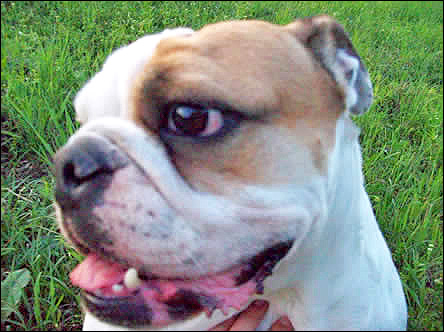
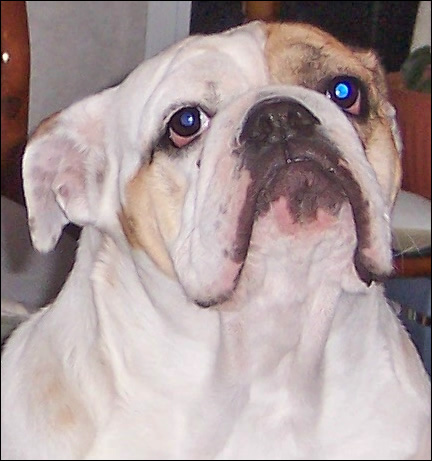
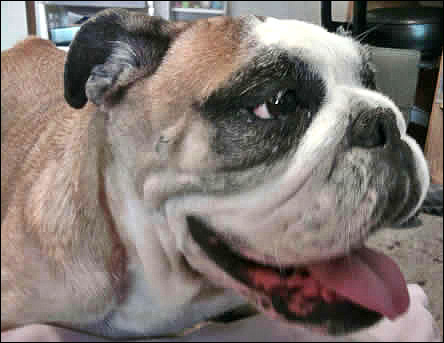
I was trying to take some action pictures of my bulldogs and then I thought, "Why? They are not action packed dogs!" So here you go.
The first one is Britches. Her official name is Fancy Britches Gabrielle. She is definitely queen of the house. She is now eight-years-old, and I have had her for seven. She is so special. She loves me. When I am home she is by my side all the time. Sometimes I'm tripping over her when I turn around. She loves popcorn and will almost do backflips to catch it in her mouth.
Next is Spice. I don't know her official name. She was only used for breeding when I got her and did not have much of a personality. She was not used to being loved and cared for. But now she has become such a special dog. She looks at you with those big eyes and her fangs sticking out and you just have to love her. She is four-years-old. I have only had her for eight months, but she definitely will win your heart.
They are so special to me. Sometimes you think they are too much trouble to care for but I wouldn't know what to do without them. Take care.
Tessa
Havana, AR
eaglesfly13@hotmail.com
Linda R. Hagen
of Van Buren, Arkansas, writes in response to "September Rain," Ebenezer Bowles' Letter from Crow's Cottage of September 9, 2010. Linda teaches Oral Communication to ninth graders and Reading to eighth and ninth graders at Coleman Junior High School in Van Buren. Thanks, Linda, for your dedication to academic excellence.
Wed 09/15/2010 07:47
Dear Eb,
I had a slightly different take on the last rain that fell. It gushed into my school classroom, taking down ceiling tiles and collecting in small ponds on the floor. Fortunately, the crash of tiles came with forewarning. I moved the students out of the classroom before the indoor storm hit.
I loved the beauty of the rain outside, of the greening of grass as it tasted nourishment, of the flowers that lifted their heads towards the heavens, of the droplets running down the window panes; BUT the rain inside was devastating!
Linda
Van Buren, AR
lhagen@vbsd.us
Eddie Jeter
of Little Rock, Arkansas, writes in response to "Giving You the Bird," Joseph Dempsey's Photo of the Week of September 6, 2010. Eddie attended high school in Fort Smith with Joseph. He is an educator, photographer, master in math and the sciences . . . . and "serves as staff to a fleet of cats," Joseph tells us. "He is also a physics nut and offers this explanation for the hummingbird appetite."
Tue 07 Sep 2010 02:32:1
Joe,
Interesting photos of the hummingbirds. A comment regarding their voracious appetites. Same applies to the tiny shrew, the smallest mammal. As the size of any solid figure diminishes, its surface area to mass increases and it will thus radiate heat faster the smaller it gets. A warm-blooded critter smaller than the hummer or the shrew would have to eat more than 100% of the time or become cold-blooded.
Yours for pedantry,
Ed
Little Rock, AR
www.jeter101@comcast.net
Audrey Madyun
of Maumee, Ohio, dropped us a line after visiting the feature "Great Plains Yucca Flower," Ebenezer Bowles' latest entry for Crow's Cottage Glossary and Compendium. A world-class chef and one of the sweetest and most thoughtful persons on the planet, Audrey is one of CornDancer's long standing friends. Her Saturday's Guest Writer contribution of November 2000, "The Lady Has DOTMFOAIM Syndrome," helped raise the foundation for our ongoing experiment in online community building. Thanks, Audrey!
Wed 04/28/2010 13:24
Hi Eb!
Neat! Your photo of the yucca flower inspired a meditation on how nature teaches a nurturer.
It's amazing how spring turns one's thought structure around. After lunch today — just about an hour ago — I sat in my car outside of the office here, enjoying the feel of the sun on my skin, listening to a singer doing her interpretation of Billie Holiday songs, and watching two robins perched on the car next to mine. Despite the noise of my car as I drove up and parked, the robins were too intent on their mission to move.
As I sat listening to music and watching the robins for ten or more minutes, I surmised they were staking out their territory. With his magnificent orange-kissed chest, the male was pecking like mad at the image of himself in the side-view mirror on the car. The female was perched on top of the mirror, chirping "instructions" while remaining very intent on his progress.
I thought the poor male, whom I dubbed "Papa," would break his beak. He went from every angle he could at the image he believed to be a predator, even running his beak around the perimeter of the mirror!
Occasionally Mama, in her brownish gray attire, jumped off her perch to rub beaks with Papa. She, too, began attacking the image of herself. So passionate was her attack that she fell off the side of the car several times and was saved only by being able to fly before she hit the ground. They duplicated this dance again and again, although I could see they were tiring.
"Dumb birds," I thought. "Now I know where the term 'bird-brain' comes from." Then, in a flash, I realized they weren’t dumb at all.
I generally park my car near our shipping warehouse, which has all kinds of nooks and crannies. These birds were probably building a nest and wanted to make the safest environment for their young. Despite the noise of my car, the fork-lift motors, and voices of the guys nearby sneaking a cigarette break, they were determined to defend their place on God's Earth for themselves and their future.
These two robins were like most of us two-legged animals in that they were trying to make our Earth a happier home for kith and kin.
When I got out of my car, they flew to higher ground, but watched me as I slowly walked into the building. I bet they are still there now.
I don't remember the singer's name. I don't remember the particular Billie Holiday songs that were playing on the radio. But I do hope I will remember this scene and the valuable lessons I gleaned from these two determined birds — even the most difficult and formidable obstacles can be attacked and eventually overcome by working together for a greater cause. And I hope to remember that everyone, even a tiny bird, has a lesson to teach if one only listens.
Audrey Madyun
Maumee, OH
Audrey_Madyun@AndersonsInc.com
Jimmy Peacock
of Sapulpa, Oklahoma, writes in response to "A Pilgrimage to the Place of the Sleeping Prophet," Ron Fritze's Planet Clio essay of March 11, 2010. Jimmy's letter was addressed to Joseph Dempsey, creator the CornDancer's Photo of the Week feature. An editor and journalist, Jimmy is also an accomplished ghost writer with an impressive list of titles inscribed on his oeuvre. He and Joseph were classmates in the long ago at Ouachita Baptist College in Arkadelphia, Arkansas.
Fri 3/12/2010 06:49
Joe:
I visited the site and read about your friend and his visit to Hopkinsville, Kentucky, to learn more about Edgar Cayce.
It so happens that back in 1993 I copyedited a 415-page history of parapsychology titled The Roots of Consciousness. It was written by Jeffrey Mishlove, who held a PhD in this field, and was an update of an earlier version from 1975. I found it fascinating and felt that the author was not only presenting the history of all aspects of paranormal activities, movements, and practitioners (including Edgar Cayce), but was also providing a scientific analysis of them — in essence debunking many if not all of them.
A table of contents of the book can be found at:
http://www.williamjames.com/Intro/CONTENTS.htm
Jimmy Peacock, Copyeditor
Sapulpa, Oklahoma
jdpedit@aol.com
visit Jimmy's website, Peacock Editorial Service
J I M M Y ' S P O S T S C R I P T :
All true copyeditors are from Missouri: Their first question is, ‘Says who?’ Their first response is: ‘Show me.’ They are not easily convinced or quickly persuaded. They are not prime prospects for snake oil salesmen, purveyors of get-rich-quick schemes, or pie-in-the-sky politicians, preachers, promoters, or other public panderers. Don’t look for them on bandwagons or following off after pied pipers or self-appointed gurus. They don’t trust ‘big mouths’ or ‘little voices,’ ‘glad hands’ or ‘glib tongues.’ They are not impressed by fat pocketbooks or inflated egos, hot shots or cool dudes, know-it-alls or self-styled ‘experts.’
They look for character, not charisma, fruit not gifts. Like God, they search for truth in the inward parts, because they know that it is truth — and not money, power, fame, or success — that sets men free.
If you are dishonest, stay away from a copyeditor, because he will see through you like a piece of wet toilet paper and will be on your case like ugly on an ape. If you don’t want to hear the truth, then don’t ask a copyeditor because he is going to tell it like it is even if he knows it will harelip both you and him. But if you are honest, if you have no ulterior motives or hidden agendas, if you really want to know the truth so you can face it and do it, then you have nothing to fear from the copyeditor, because to him integrity is the ultimate virtue — and either you have it or you don’t. It’s just that simple.


Pat O'Brien
of Fayetteville, Arkansas, writes in response to "A Door on North Colorado Street," Ebenezer Bowles' feature for Crow's Cottage Glossary and Compendium of March 3, 2010. A family man with an eclectic array of interests, including urban excursions on his Segway, Pat and his wife Tammie spend much of their time as "soccer parents" at the games of their two daughters. The family dog Max guards the house while they're gone.
Fri 03/05/2010 08:13
Hello Eb,
I like the wasp nest on the door. Keeps a person aware of their journey from one world to the other.
The photo of the Gem is interesting. Looks like someone spent a lot of time and energy to get the façade looking good. Funny to see it tacked onto a pre-fab structure. What do they call those things that look like a tube cut in half? They remind me of the barracks that Gomer stayed in on the Gomer Pyle show.
Your stories remind me of Zen and the Art of Motorcycle Maintenance. Visiting places, trying to make connections and draw some meaning and understanding out of it. Keep up the good work.
Your kindred spirit,
Pat O'Brien
maxobrien@sbcglobal.net
E D I T O R ' S N O T E : The Gem looks like a modified Quonset Hut. The U.S. Navy built about 150,000 of them in World War II. After the war was over, the surplus huts were sold for a thousand dollars each. You see them everywhere. The one in the photo looks like it has been covered with some sort of exterior plaster.
Karen Steele
of Dodge City, Kansas, writes in response to "Three Aussies," Ebenezer Bowles' Letter from Crow's Cottage of January 19, 2010. From her office at the Kansas Department of Wildlife and Parks, Karen spreads goodwill and a helpful hand to any and all who come her way. She is a devoted champion of the natural wonders of the Sunflower State. Karen's letter shares experiences, both sad and joyous, that are familiar to each of us who enjoy the company of dogs.
Tue 01/26/2010 10:42
Ebenezer,
I had to reply after reading about the three puppies. We lost our dog of nine years the week before Christmas. Her name was Jane and looked very similar to Isis. Miss her terribly.
On January 6th my youngest son and daughter ventured to the animal shelter. We spotted a very shy little border collie that someone had thrown over the shelter fence. We decided she would be the perfect puppy. We were able to pick her up January 12th and as of today, her shyness is long gone. What a handful. We miss Jane but have welcomed Lexi.
Thank you for the newsletter. Enjoyed the story.
Karen
karens@wp.state.ks.us
visit one of Karen's favorite websites
Cindy Williams
of the rural outskirts of Berryville, Arkansas, writes in response to "Pomona of Kentucky," Ebenezer Bowles' Crow's Cottage Glossary and Compendium entry of December 7, 2009. Cindy is a teacher, farmer, writer, and photographer with a great brood of children and grandchildren. She sent us four photos. Thanks, Cindy!
Tue 01/05/2010 08:40
Hi Eb,
Taking pictures is one of those things I really love to do, but I don’t have the time to spend trying to get better — it’s just fun. Anyway, these are some of my favorites because there are stories in the imagery . . . . but I guess if one really looks, he can find a story somewhere in the veins of just about any picture. Since I have no experience, what kind of pictures make cool pictures?
I have plans for most of these; so, you’ve inspired me to share. I love to take close-up pictures of flowers, too. Odd, but they make great décor. The black and white is my four sons. This was un-posed, unplanned; same with my little grandkids.
I really liked the story about Pomona. Thanks for sharing and for letting me share.
Cindy
cindymw@windstream.net
P.S. Yes, life is good!
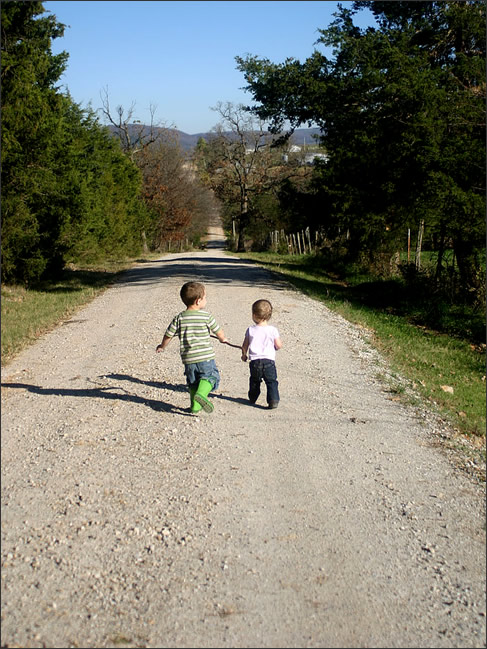
Brother's Guiding Hand
My grandson Cooper, age three, and granddaughter Cara, age 2, walk the long road to the creek. Big brother’s hand guides the tiny path of his sister.
November 7, 2009
Christmas Flower
The Christmas flower in full bloom deviates from its slapdash petal placement by its deep, calm satin flow of pink and white.
November 20, 2009
'Making Chicken'
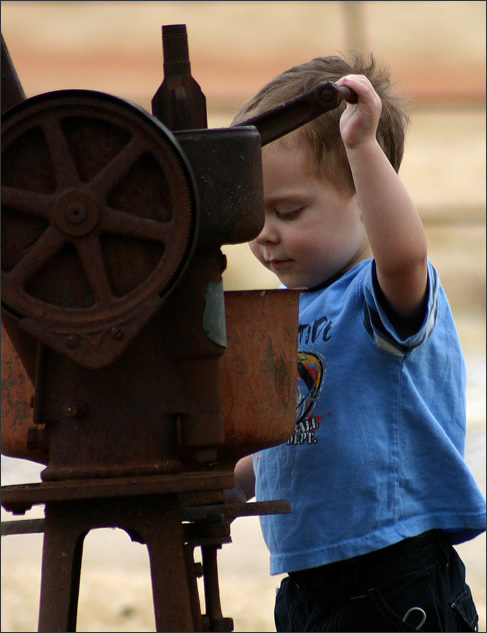
Grandson Cooper investigates the workings of an old grinder (actually, it’s a cream separator). He was “making chicken” in the grinding pot, farmer style, on Papa and Grandma’s farm.
February 7, 2009
Sons and Brothers
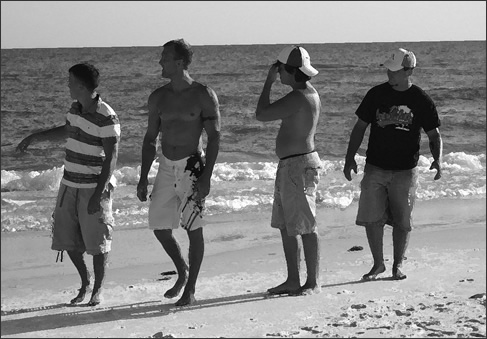
Four of my sons: from left to right, Jerod, Joshua, Jordan, and Justin in Panama City Beach, Florida. I used Photoshop to do a simple sketch. They were looking at nothing in particular, and as they looked away, I captured their distant anticipations with a look of my own.
July 17, 2007
Jeremiah Estes
of Combs, Arkansas, writes in response to "Say No to the Fat Tax (and deadly sins, too)," Ebenezer Bowles' Journal to the Corvus entry of October 8, 2009. Jeremiah is a musician, lyricist, and landscape artist.
Sat 10/10/2009 10:34
Dear Ebenezer,
Thanks for the post about the fat tax. I agree that such a "tax" should be viewed as an assault on what few liberties we have left. It’s a poor politician’s short-term solution to long-term problems that aren't being addressed. Everyone is looking for any dime they can dig up in this latest economic downturn to help ease the contraction pains of a bloated society. With this particular approach, they bring to the spotlight an issue, obesity, that most of us understand to be a real dilemma, but they approach the issue as all good capitalists do — with the pocketbook in mind.
I believe something needs to be done about obesity in this country. It’s rare when I look to the government as the entity to best "do" anything, but in this case there are steps it could take.
How about health classes in school that teach children about industrial farming practices and the suspect quality of food they provide? What about a 30-35 hour work week so people actually have time to cook dinner? What about preventative health care to catch obesity in the youth? What about tax incentives for buying local foods? Oh, wait we couldn't have that. It would hurt shipping revenues, tire makers, gas pumpers .... THE ECONOMY? Heavens, what was I thinking.
But wait, maybe that’s what we need: an even worse economy, so that people simply can't afford enough food to become obese. Problem solved. What I'm really trying to get at here is that we can't expect great ideas to come from government, politicians, aristocrats. Just to be a member of one of the aforementioned classes, one is often little more than a servant to one corporate lobbyist after another. Thus, any "great ideas" they put forth will be marred with the earmarks of wealth redistribution and protection of the stock holder.
Great ideas must come from the people, the private sector, the not-for-profit. Great ideas must be pressed for, hollered for, cried for, and at times bled for, so that the populace as a whole can hear the call to righteousness, a call that rises above American Idol and Monday Night Football. It’s a call that inspires people to spring into action. Only then, when people act, will the government be receptive to doing what is good for all.
Jeremiah
jestes70@juno.com
Ted Mead
of Austin, Texas, responds to "Dining at the Black-Eyed Susan," Ebenezer Bowles' entry of July 17, 2009, in Crow's Cottage Glossary and Compendium. Ted is a chemist, United States Marine, teacher, and doctor of philosophy. He writes:
Sat 07/18/2009 22:25
In my declining few years (nay, months) I too become fascinated with the complexity of life. I can sit on the back porch and gaze at trees in the sunlight doing what I, a fairly competent chemist, could never dream of doing — synthesizing carbohydrates from two of the most stable and unreactive compounds in the environment, carbon dioxide and water. That, I can assure you, is going way, way uphill thermodynamically.
It seems that if energy, like sunlight, impinges on inert matter, organization of that matter to some higher form often obtains. Kind of the reverse of the revered second law of thermodynamics. I think this impinges on the second super ultimate question*: how did life originate? We know it started about four billion years ago, not long after the earth cooled and solidified. The British WWI poet Wilfred Owens alludes to this in his short poem “Futility,” which I commend to the attention of all.
While I reflect on this, I note a tiny, tiny critter, about the size of a dot a well-sharpened pencil might make, scurrying across the back of my hand on an errand of some urgency. I know there are zillions of microscopic creatures, but this chap is on the very edge of the macroscopic. A perfect entity which, I presume, eats, eliminates, copulates and perhaps dreams. He certainly has purpose, else why the mad rush between my thumb and forefinger?
There are more things between heaven and earth, Ebenezer, than are** dreamt of in your philosophies.
*The first super ultimate is, “Why is there something rather than nothing?"
**My spell check insists this “are” should be an “is.” The help that you get these days.
Ted Mead
Semper Fidelis
profeted@yahoo.com
Fri 06/19/2009 09:51
Jim Foster
of Gautier, Mississippi, writes in response to "Btsfplk or Addams" Joseph Dempsey's Photo of the Week of June 14, 2009.
Dear Joseph,
This week's photo struck a familiar nerve. My paternal grandfather and members of our family lived in a similar structure back before I was a tricycle motor and even up through my early teen years. It was located in Utica, Mississippi, which is located a short distance south of Jackson, the state capitol. To get there took an eternity of winding gravel roads, especially to a small boy crammed into a back seat with four siblings.
What you called shotgun entrance, we knew it as a "dogtrot" house. The family sleeping quarters were on the right and the living area on the left where the parlor was. The kitchen was at the back left of the house where my aunt, who died last week at 96, cooked all the family meals on a wood-burning stove, a big cast-iron job that she harnessed and from which she wrangled some of the best biscuits ever — not to mention mounds of fresh game, chicken, stews and vegetables cooked to perfection in bacon fat. It was on my grampa's lap I first tasted fried squirrel. He tempted me with a fried squirrel eye so the story goes, and I eagerly popped the little orb into my mouth to gales of family laughter — slightly tinged, I suspect, with a sadistic hint.... Of course, grampa and my father tried to teach me me to swim by throwing me into the creek, where I proceeded to do a better job of swallowing mud than anything else.
The dogtrot served its purpose not just for dogs; it also was a convenient and protected spot to store watermelons out of the sun before they were delivered to grocery stores in Jackson. My grampa and uncle were "truck" farmers, specializing in watermelons, peanuts, and corn. They dabbled in cotton, too, but apparently not that much in acreage or enthusiasm. A note on watermelons stacked in the dogtrot: There may be no more comfortable pallet for a small boy's nap than to scale a melon mountain cooled by the shade and wedge himself into a crevice.
The house was without electricity until the late 50s and also was without indoor plumbing. Grampa would warn us kids not to take the path to the outhouse in the morning until he checked it for snakes. And, I still remember the coal oil lamps in the parlor, which were rarely used since most of the conversations took place along the dining bench or sitting on the front porch. Evening conversations commenced right after supper and lasted until the mosquitoes drove everyone inside to bed.
On the downside of the dogtrot, it was the cause of my grandmother's death. Because grampa put foodstuffs within the dogtrot, it became a rare attraction for black bears that roamed that area back then. So grampa kept a shotgun underneath the bed just in case a bear came calling. One morning after grampa and the boys had gone to the fields, my grandma was changing the linens on the bed when she accidentally tripped over the shotgun. It discharged and ended her life. My father was 17.
Until the day he died, grampa never forgave himself for grandma's death and took to drink to ease his remorse, the first one of the Foster boys to succumb to that tactic, I'm told, but certainly not the last.
My dad was forced to quit school when grandma died to prevent grampa from taking his own life, so deep was his grief. When my aunt and her husband moved back to the home place, my father departed the dogtrot in Utica for the CCC (Civilian Conservation Corps) camp in Vicksburg, where he would one day spy the lovely young woman that would become his wife and my mother.
Jim Foster
Gautier, MS
jfoster761@bellsouth.net
Honoree of the Great and Lasting Friendship
with Joseph P. Dempsey
Sun, 26 Apr 2009
John Matviko
of West Liberty, West Virginia, writes in response to "The Right Notes: Conference about Pop Culture at New Orleans Aligns with Educational Goals of LitTunes," Christian Goering's report for LitTunes of April 22, 2009.
Christian,
Thanks for the kind comments about PCA/ACA — as a long-time member I'm always excited to hear from those who have discovered us.
I signed up for your newsletter. I am in my 40th year of teaching, and your website reminded me of my early days of teaching high school English. In particular, it reminded me of the early seventies when I used Phil Ochs (a sixties folksinger/protest rocker) in my 10th grade English class. I used his musical versions of Noyes "The Highwayman" and Poe's "The Bells." Not coincidentally, my second paper at PCA in 1989 was an analysis of Ochs and the '68 March on Washington.
John Matviko
West Liberty State College
(I did the paper on doo-wop and PBS.)
Mon 02/09/2009 16:55
Tony Foster
of Havana, Arkansas, a high school science teacher, computer network engineer, musician, and former television cameraman, sent us three photographs and a thoughtful missive about his home turf. Tony writes:
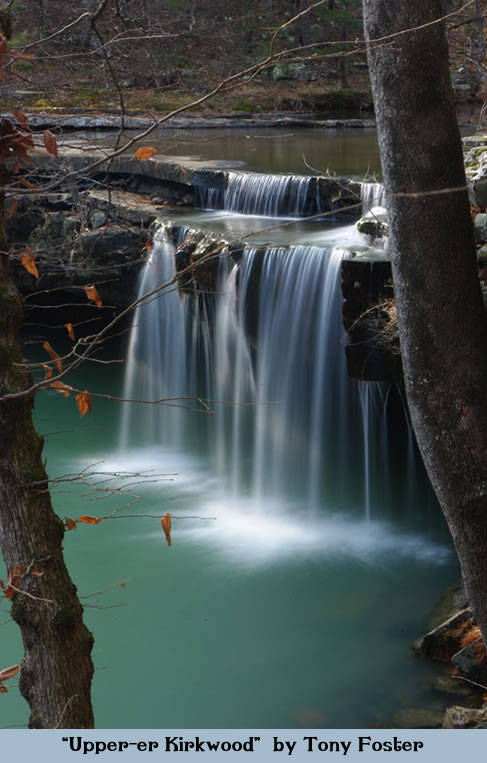
Not too far southwest of our beloved Western Yell County High School in the beautiful Ouachita Mountains is a locally famous swimming hole called Kirkwood. I’m sure some wise old soul knows the origin of the name of the place . . . but I confess I am not that aged. This punch-bowl pool is fed by a cool, clean mountain creek that often slows to a trickle in the drier months. Sadly, the area is often littered with bottles, cans, and the occasional discarded refrigerator. Littering ticks me off to the highest of ticktivity.
When the water is right, not too soon after a rain, nor too long since, there flows a wonderful waterfall down along a large boulder into the cool blue-green pool of Kirkwood. A lovely sight, a delightful sound indeed. This, however, is not the only wonder of this little creek. Not more than a quarter mile upstream is another pool near equal to Kirkwood and churned by its own stair-step waterfall. But wait, wait — there’s more. Take another little hike upstream from the second hole and you will come upon a third pool with an eight-foot waterfall pouring over a thin ledge with steep rock cliffs rising on both sides.
I absolutely love taking the drive up to these waterfalls. Not only for the serenity of the place, but also for my familial connection to the area. The Fosters came to Yell County in the 1840s and set down roots in the area southwest of Havana in the 1850s.
The drive south on Walnut Grove Road takes me past the farm where I grew up and spent countless hours roaming around and helping to raise the crops. Further along the road in a southwesterly direction I pass the Foster Homestead where my granddad, and his dad, raised their families. It just feels like home — and I feel like I’m here to stay.
A little about the photos: The shots of “Upper Kirkwood” and “Upper-er Kirkwood” were taken on a partly cloudy January day with ISO 100, a polarizing filter, and the highest f-stop my lens would allow — around f32 or higher. The shot of the waterfall at Kirkwood was taken the night before at just before midnight by the light of a nearly full moon. No flash. No artificial light. It is a 3-minute exposure with f1.7 on an old 50 mm manual focus lens. All three shots were taken on a Pentax K20.
Thu 01/29/2009 14:50
Vicki Souza
of Havana, Arkansas, a high school English teacher, wrote: "The 11th graders have been 'deconstructing' Poe’s 'Raven.' I was hungry, and the rhythm of the poem was in my head, so I wrote. I’m sending it to you for your daily chuckle."
Once upon a boring morning, while I studied, yawning, poring
Over a long and dreary poem about a man and raven black,
While I sat there, doodling, drawing, suddenly there came a clawing
As of some monster rudely gnawing, gnawing at my breakfast’s lack.
“Tis some Hunger, I muttered, “gnawing at my breakfast’s lack —
Only this — I need a snack.”
Ah vaguely I can distinguish, it was in fourth-hour English
And my thoughts I did relinquish of the poem’s forgotten lines
Eagerly I craved a snack cake, or a cookie, freshly baked,
To ease the sniggling pangs, pangs of famine fine
Of the harsh and hollow pangs that occupied my mind
Of hunger, a sure sign.
And the thoughts of Little Debbies, Nutter Butters, and pink Zingers
Thrilled me, filled me with horrendous cravings never felt before.
So that now, to stop the gnawing, I chewed some gum,
Salivating, “Twill do for now, “til I can get to the store —
Til I can reach the bakery or the chocolate candy store — to stop
these pangs
Forevermore.”
Presently, though, my mind remembered that somewhere, sometime
in December
I had put a box of Swiss Miss hot chocolate in my desk’s topmost
drawer.
Hesitating then no longer, as hunger plagued me stronger, stronger
Here I pulled the desk drawer open, thrilled to my stomach’s core —
Mouse poop there — and nothing more.
Deep into the drawer staring, long I sat there, cursing, swearing,
Uttering words no teacher should even know of, much less stoop
to say.
But the mouse had already spoken, had already left his token,
And my hunger stayed, unbroken, and held me in its sway —
So I began to pray.
“Lord, I really need a cupcake, or a couple of those no-bakes
Since the little mouse decided to take my stomach’s only hope.
Please send me some provisions, so I can make decisions
And grade these essay revisions — Help, me, Lord, to cope!”
But the Lord said, merely, “Nope.”
“You say you’re on a diet, eating foods you claim are light,
But you sneak around and bite into whatever you can find.
Until you learn your lesson, from me you’ll receive no blessings
Of cookies, steaks, or dressing, or three Happy Meals combined.
Eat some carrots — you’ll be fine!”
And the Monster, talons clawing, still is gnawing, Still is gnawing
At my stomach’s tender lining which by now is getting sore.
And his wicked, ceaseless howling, and the mouse’s constant prowling
And my tummy’s endless growling
Shall be silenced — Nevermore.
Tue 01/27/2009 10:05
Michael Schaefer
of Conway, Arkansas, writes in response to "The Coming of the O," Ebenezer Bowles' Letter from Crow's Cottage of January 23, 2009. Michael, a professor of English at the University of Central Arkansas, plays guitar and sings for "The Boomers." He is an acclaimed scholar of the nineteenth century writer Stephen Crane.
I found your essay more than readable, Eb; I found it multilayered, carefully modulated — in short, controlled without being rigid, a nice play on the issues of control and free will it addresses. As we both sit under the lowering gloom of ice storm and financial meltdown, I suppose the need of relinquishing control of all the things that lie beyond our individual wills weighs strongly on our minds. I very much like your point about the link between leisure — true leisure, to think and create — and austerity; you and I are both very much in accord with Mr. Thoreau on that one, I think.
With regard to our new president, unlike you, I wasn't sure we'd ever elect a man of color in my lifetime (kudos to you for your certainty in that respect), but I'm hopeful — hopeful that a thoughtful and principled pragmatism will now supplant an ignorant and destructive ideological rigidity.
. . . .
I try, with varying degrees of success, to keep uppermost in mind through all my endeavors — teaching, writing, working with the guitar, and generally living — the wise words of Mr. Nabokov:
In art as in science there is no delight without the detail, and it is on detail that I have tried to fix the reader’s attention. Let me repeat that unless these are thoroughly understood and remembered, all ‘general ideas’ (so easily acquired, so profitably resold) must necessarily remain but worn passports allowing their bearers shortcuts from one area of ignorance to another.
All good things to you,
Mike
visit Mike's website
It's your turn to contribute.
Send us your comments, creations, photographs, or any other expression of your universe. We'll share it with CornDancer's online community.
Our address:
readers@corndancer.com
 |