
|


LitTunes
Is Featured
in Innovative
Lesson Plan on
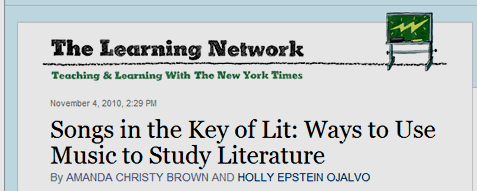
The Learning Network
of The New York Times Education Section.
November 4, 2010
"How can music help illuminate literature? And how can literature teach us about music?" With those two questions, Amanda Christy Brown and Holly Epstein Ojalvo launch an innovative and robust lesson plan that is nicely attuned to the goals and mission of LitTunes.
Published by The Learning Network of The New York Times, "Songs in the Key of Lit: Ways to Use Music to Study Literature" directs teachers to look at connections between the music of French composer Satie and Plato's Dialogues as the starting point for lesson development. The Sate-Plato connection is one of several ideas put forth in a wide-reaching and smartly organized survey of the concept of teaching literary works with the aid of popular and classical music.
The thoughtful teacher will quickly see that Brown and Ojalvo are providing flexible guidelines and foundational concepts to inform the creation of custom lessons encompassing a multitude of disciplines and genres: English language arts, music, drama, fine arts, and communications. "Songs in the Key of Lit" also features links to related resources.
Among those related resources is LitTunes, which is featured under the subhead "AROUND THE WEB." Thanks, teachers Brown and Ojalvo! We are honored to be included in your excellent lesson plan and join you in the pursuit of academic excellence for our students. Please click the graphics below to visit the web page, "Songs in the Key of Lit . . . ."
LitTunes
Lesson Plan Initiative
LitTunes is working to build on the success of our first year by expanding our library of lessons, which are designed to enhance the teaching of English through the inclusion of music. While many of the current LitTunes lesson plans are units of instruction designed to extend through several classroom sessions, we are eager to publish shorter lesson plans that can fit neatly into one class period.
Specifically, we seek lessons about one or more of the following subject areas:
1. Building Connections to Literature
Do you use a specific piece of music to help teach a specific piece of literature? Whether it is Tupac Shakur or The Byrds, Jack White or Frank Sinatra, all genres and styles of music are welcome on LitTunes as long as they have been successfully field tested in your classroom and help students connect with novels, poetry, or other forms of literature. You are invited to consult the LitTunes Connections database for information and inspiration in helping you create teacher-tested, kid-approved lesson plans.
2. Writing with Music
How does the use of popular music enhance your students' writing? Is there a lesson you teach to introduce and establish certain genres of writing in your classroom? For example, do certain songs help illustrate narrative or dialogue?
3. Music as Literature
Sometimes a piece of music becomes so important that we include it in our curriculum and teach it as a work of literature. Several songs have been anthologized over the years in poetry books. This area seeks lesson plans that illustrate and explain how songs can cross over into the literary curriculum.
4. Discussing Music
Whether it is social protest or love, songs are excellent introductory tools for class discussions about literary texts. Lesson plans for this area could include one song or several that spark lively discussions about issues relevant to learning goals.
5. Music Lyrics as Poetry
For decades teachers have looked to popular music to help them teach the elements of poetry. Maybe you have a lesson that is useful for teaching metaphor, hyperbole, personification, voice, or other literary devices. Examples include "Life as a Highway" by Tom Cochrane to teach metaphor or "Elanor Rigby" by The Beatles to teach found poetry. Your lesson plan can focus on a single song and a related element of poetry, or several tunes and poetic techniques.
The format you choose for presenting your lesson plan to the LitTunes community is totally up to you. Feel free to browse the library of LitTunes lesson plans to see how others organize their lessons, or adapt your plan to a format that works best for you. All we ask is that your lesson be designed to serve the classroom teacher and the school curriculum – and that it fits the LitTunes philosophy of connecting music to literacy and literature.
Please send submissions and inquiries to littunes@corndancer.com— today! Your renumeration will be the same each of us receives at LitTunes: a hundred credits of altruism and a solid line-of-credit in kudos from your peers in classrooms across the U.S.A.
Downloads and Updates from the 2008 NCTE Conference in San Antonio, Texas
The 2008 National Council of Teachers of English convention in San Antonio (Nov. 20-23) was tremendous. Thanks to all of the fine people who attended our presentation and for the continued interest in the LitTunes initiative. Estimates ranged between 175 and 215 convention goers in the standing-room-only presentation on Friday, November 21.
Above and beyond mere numbers, a palpable energy flowed through the room, and the enthusiasm expressed by so many during and after the presentation was nothing short of inspirational. The room was full of teachers searching for ways to connect to twenty-first century learners. Yes, music is one proven way of doing just that. But my colleagues Suzy Oertel and Kate Erickson offered excellent strategies about text messaging and social networking to help teachers meet the students on their turf.
As promised, the presentation PowerPoint and handout are available for download. You'll find the links at the end of this report. Use and share them at will. And, as always, direct questions or comments about LitTunes to me at cgoering@uark.edu, about text messaging to Suzy Oertel at oertesuz@usd437.net, and about social networking to Kate Erickson at kateerickson@usd475.org.
Register for LitTunes Updates.
If you attended the session in San Antonio and were not able to sign-up to receive LitTunes updates via our newsletter, please send an e-mail to littunes@corndancer.com with the subject "register." The newsletters are sent out when new material — lesson plans, essays, connections — are posted. LitTunes is not commercial in any way. Your e-mail address is held in the strictest confidence.
12-3-08 CG
Tunes, Texts, and Social Networks
as Engaging Literacy Practices
in the Teaching of Literature
NOTE: The file is about 5 MB. Fast connection required.
Get Connected:
Reading with the Music in You.
Of Mice and Men Special Project
By Barbara Jaquish
Science and Research Communications Officer
The University of Arkansas
Fayetteville, Arkansas
November 28, 2007
Discussing Song Lyrics
Helps Students Open Connections to Literary Concepts.
A former high school English teacher turned literacy researcher at the University of Arkansas says that discussing song lyrics in the classroom can help students connect in multiple, complex levels with traditional literature. Christian Z. Goering now hosts a Web site for teachers to share links between literature and lyrics.
Dr. Goering presented his work at the recent annual convention of the National Council of Teachers of English in a paper titled "Springsteen, Steinbeck and The Bastard Sons of Johnny Cash: Connecting Music to Literature." He emphasizes the ways song lyrics can open up literature and literary concepts to adolescents, but he is not suggesting replacing literature with popular culture in high school classrooms.
"What I am suggesting is that we pair pieces of classic literature with contemporary music, allowing some of the natural, thematic connections to come to the surface and allowing our students to see these connections and the relevance to their own lives," Dr. Goering said.
Students Choose Music
Music lyrics can be an especially effective hook, given the importance of music to adolescents.
Dr. Goering cited a survey that asked which form of entertainment teenagers would take to a desert island. Students in seventh, ninth, and eleventh grades chose music over television, books, computers, video games, radios, newspapers and magazines.
Lyrics can serve as a bridge for students, Dr. Goering noted, from material that may be familiar or easily understood to classic literature that may be more difficult or challenging. For example, "California Sky" by the Bastard Sons of Johnny Cash takes listeners from "out in Oklahoma where the hard winds blow" on a cross-country journey that can open up a discussion of John Steinbeck's The Grapes of Wrath.
"Tunes, I discovered, directed students toward an avenue where conversation about more serious, literary topics could take place," Dr. Goering said. "Pop music dismantled roadblocks between students and their peers, between students and literary texts, and between students and their teacher."
A Lyrical Pathway
to Key Literary Concepts
Through considering popular music and traditional literature, students "discover layers of meaning in classic works" while grappling with key literary concepts. The use of popular music encourages students to recognize poetic devices, identify the narrative voice, express literary themes, improve skills in literary analysis, develop an emotional reaction to a work, and deepen their understanding of other literature.
Dr. Goering found that students participated more actively while reading when they attempted to make connections between songs and other texts. These connections developed both a key skill of expert readers — the ability to recognize the relationships between one text and another — and students' skills in critical analysis.
"It is the process of reading one text while thinking of others that truly makes literature relevant to students' lives," Dr. Goering said.
Taste, Evaluation, Judgment
He also noted that students understand that different people look for different things in music and like different types of music. The ability to understand taste, evaluation and judgment about music translates well to an acceptance of divergent opinions about literature.
Dr. Goering is an assistant professor of secondary English and literacy education in the College of Education and Health Professions. Dr. Goering's Web site, www.LitTunes.com, offers research into the use of music lyrics in teaching literature, examples of pairings of specific tunes and literature, and a place for teachers and students to contribute their own pairings.
C O N T A C T :
Christian Z. Goering,
assistant professor, curriculum and instruction
College of Education and Health Professions
(479) 575-4270, cgoering@uark.edu
C O N T A C T :
Barbara Jaquish,
science and research communications officer
University Relations
(479) 575-2683, jaquish@uark.edu
LitTunes is an educational outreach directed by Dr. Christian Z. Goering,
Assistant Professor of Secondary English/Literacy Education
at the University of Arkansas.
LitTunes is a part of the CornDancer family of developmental websites.
CornDancer has participated in the World Wide Web since the summer of 2000.
Submissions are invited.
Contact webmaster at threadspinner@corndancer.com
|
|