Japan has a continuous cultural history far older than that of the United States
(as settled by Europeans), and has therefore fallen into some pretty firmly entrenched
patterns of behaviour. These patterns are changing drastically during the last ten or
twenty years -- particularly since the advent of satellite television.It has been said
that due to the worldwide prevalence of MTV (not to mention Disney and McDonalds),
teenagers in Japan, India and the U.S., for example, have more in common with each other
than they do with their own parents. While this may be true to some extent, even the rebellion
in Japanese teens has a certain distinct Japanese flavor to it. Why? We're talking about more
than 16 centuries of cultural brewing, and that's just since the end of what Japanese consider
to be their "prehistoric" period (the Jomon {10,000-300 B.C.} and Yayoi {300 B.C. - 350 A.D}
periods).
How much of a role does climate play in the formation of culture? Quite a lot. Civilizations
that took root in the deserts of the Middle East were nomadic, constantly searching for water
and food in a hot, harsh climate. Mediteranean civilizations like the ancient Greeks and Romans,
blessed with the tradewinds and the natural harbors, became seafarers and merchants, trading
goods that were plentiful for goods that were in demand.
In the Asian monsoon belt, early civilizations were made up of rice farmers. Early religions,
like the indiginous Shinto, were tied to the land and the agrarian cycle. People didn't move
around much and they began to form tribes, or clans, to increase their holdings and security.
Arable land was the supreme coin of the realm. How to manage that fertile rice-producing land
-- and ultimately get more of it for themselves -- was the primary concern of the early Japanese
monarchs.
Other environmental elements that have shaped the Japanese consciousness are earthquakes,
typhoons, and the fact that their nation is an island chain roughly the size of California,
with most of the interior very mountainous and -- to early civilizations -- uninhabitable.
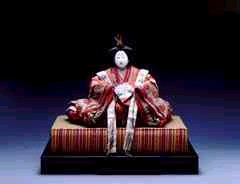 This doll has the style of the "yusoku-bina". Its costume, the "osuberakashi" hair style of,br>
the female "hina", and other features reflect the features of the "yusoku-bina", but it is
This doll has the style of the "yusoku-bina". Its costume, the "osuberakashi" hair style of,br>
the female "hina", and other features reflect the features of the "yusoku-bina", but it is
larger in size, more like a "kyoho-bina" and luxury is emphasized. This is the "hina" that
became the archetype of the present day "hina" dolls. osuberakashi: A hair style of the old
days. This was only employed among imperial family members when they wore formal costume.
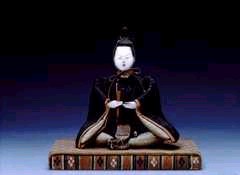 Prior to the "yusoku-bina", the costume of the male "kyoho-bina"
etc. adopted the style of a ceremonial hunting costume the "kariginu", whereas the female doll was
dressed in "itsutsuginu", a set of clothes consisting of five robes and a ceremonial red skirt that
had an aristocratic appearance. However, this fashion did not perfectly reflect the formal court costume
of the period. Thus, the persons responsible for costume at the Imperial Court, together with the Yamashina
and Takakura families, dressed their dolls accurately in costumes that accorded with the dress conventions of
around 1755. This was the beginning of "yusoku-bina".